The Story
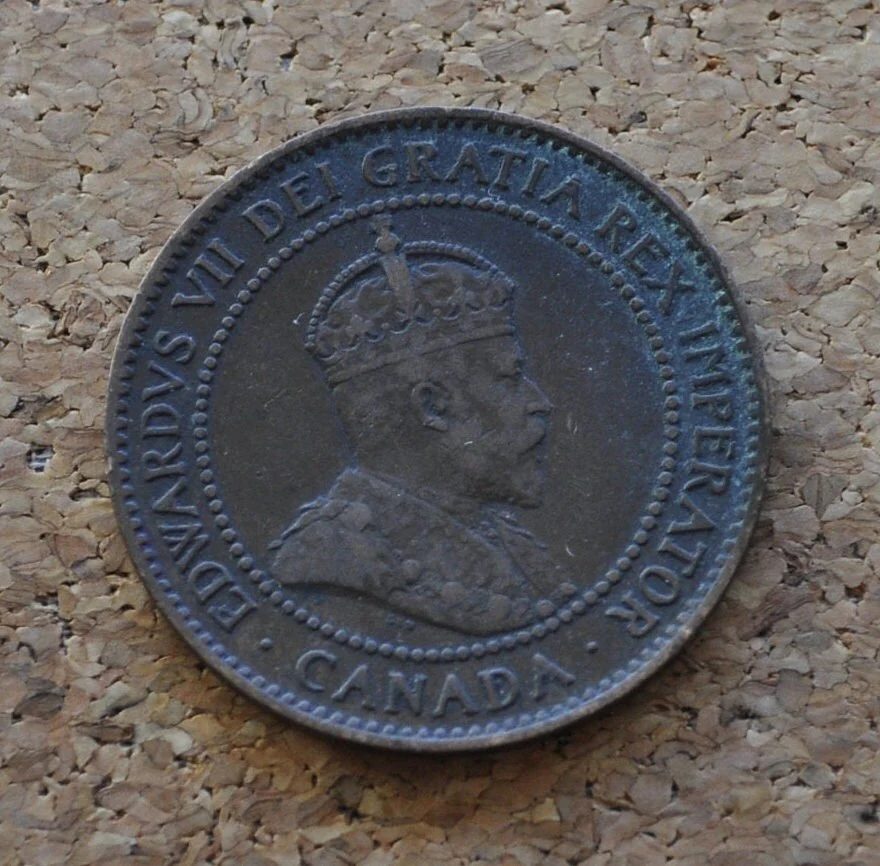
Unique Error Strike: Look at the rim of the obverse between the "C" in Victoria, and the "R" in Gratia. The rim is flat, without the beaded edge that should be there. This is likely a result of the die s being misaligned. If the upper and lower dies are not perfectly parallel and/or centered, the striking pressure will be uneven. This leaves the design details and the rim flattened or completely missing on one side of the coin.
The photographed 1894 Canadian Cent exhibits luster and detail that of a choice AU. This coin may be uncirculated, but we are listing it as an AU.
The first Canadian cent was minted in 1858 and had a diameter of 1 inch (25.4 mm) and a weight of 1⁄100 pound (4.54 g). These cents were originally issued to bring some kind of order to the Canadian monetary system, which, until 1858, relied on British coinage.
The large cents of 1858–1920 were significantly larger than modern one-cent coins and even slightly larger than the modern 25¢ piece. After Confederation, these large cent coins were struck on the planchet of the British halfpenny and were roughly the same value. Pennies were issued sporadically in the third quarter of the 19th century. They were used in the Province of Canada, New Brunswick, and Nova Scotia upon Confederation in 1867. New Brunswick and Nova Scotia had issued their own coinage prior to that date, with British Columbia, Prince Edward Island, and Newfoundland continuing to issue "pennies" until they joined Confederation. The coin was reduced in size to its current size to match the size of the American penny.
The obverse features Queen Victoria, while the reverse contains large lettering surrounding by a laurel wreath design.

Details & Craftsmanship
Every detail has been carefully considered to bring you the perfect product.
Description
Unique Error Strike: Look at the rim of the obverse between the "C" in Victoria, and the "R" in Gratia. The rim is flat, without the beaded edge that should be there. This is likely a result of the die s being misaligned. If the upper and lower dies are not perfectly parallel and/or centered, the striking pressure will be uneven. This leaves the design details and the rim flattened or completely missing on one side of the coin.
The photographed 1894 Canadian Cent exhibits luster and detail that of a choice AU. This coin may be uncirculated, but we are listing it as an AU.
The first Canadian cent was minted in 1858 and had a diameter of 1 inch (25.4 mm) and a weight of 1⁄100 pound (4.54 g). These cents were originally issued to bring some kind of order to the Canadian monetary system, which, until 1858, relied on British coinage.
The large cents of 1858–1920 were significantly larger than modern one-cent coins and even slightly larger than the modern 25¢ piece. After Confederation, these large cent coins were struck on the planchet of the British halfpenny and were roughly the same value. Pennies were issued sporadically in the third quarter of the 19th century. They were used in the Province of Canada, New Brunswick, and Nova Scotia upon Confederation in 1867. New Brunswick and Nova Scotia had issued their own coinage prior to that date, with British Columbia, Prince Edward Island, and Newfoundland continuing to issue "pennies" until they joined Confederation. The coin was reduced in size to its current size to match the size of the American penny.
The obverse features Queen Victoria, while the reverse contains large lettering surrounding by a laurel wreath design.